Pages

Thursday, January 12, 2017

‘It’s a Decentralised Emergency… A Pyramidal Mafia State’: Arun Shourie on Modi Sarkar

In an explosive interview, the former BJP leader Arun Shourie hits out at Prime Minister Narendra Modi.

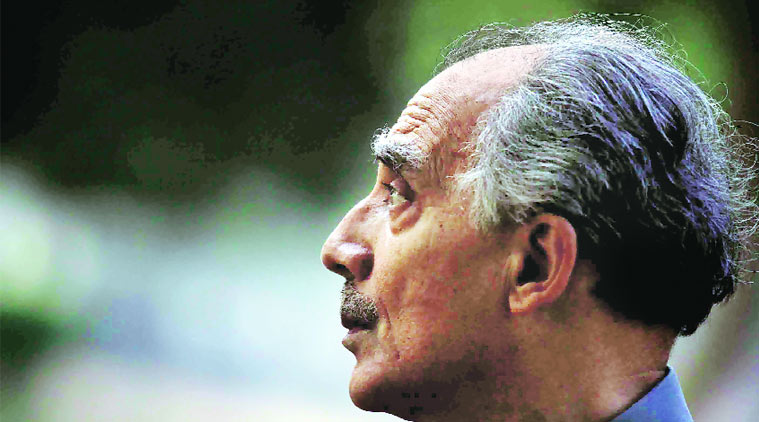
File photo of Arun Shourie. Credit: Reuters
As part of the research for my book, I Am a Troll, I interviewed the former Bharatiya Janata Party leader Arun Shourie – a man who has also been viciously trolled on social media by ‘bhakts’ when on the Karan Thapar show he first went public with his criticism of the Narendra Modi government. The interview with Shourie, who was a minister in the Atal Bihari Vajpayee-led NDA government from 1999-2004, was conducted in the summer of 2016 and the edited transcript is being published in The Wire for the first time.
§
Swati Chaturvedi: Narendra Modi is the only one among world leaders who follows abusive handles. You and your son, who has cerebral palsy, were attacked and abused by these handles followed by him when you criticised him in an interview to Karan Thapar. They even said that you deserved your son’s illness as your karma for criticising Modi.
Arun Shourie: Yes, by following them Modi is giving the message: I am following it. You are following, then you are encouraging it, saying ‘Bhaiyya main dekh raha hoon tum kitni galiyan dal rahe ho’ (Boys, I’m watching, to see how many abuses you come up with). Next I hear he had a reception for them. You are receiving the same fellows in the PM’s official residence. Then the encouraged fellows put up their photos with Modi. Next I heard one of them had been made the chief of the BJP’s IT cell. So obviously it is now a governmental operation, a party operation. And, this is one of the many instruments being used to silence voices in the whole country. So abuse is one, denial of access – just see now in Rajasthan, the Rajasthan Patrika has been denied advertisements by the state government because they wrote something about the central government.
SC: You fought the Emergency. I was not even born then. Is this anything at all like that era?
Shourie:  It’s a decentralised emergency. What we are going towards is a pyramidal decentralised mafia state, where local goons will belabour anyone whom they think is doing something wrong. The central people will look the other way. The central people will provide a rationale for the goondas at the local level. Like “gau rakshaks’’, like “love jihad” – this becomes the rationale for me to beat up anybody. It’s not love for the cow but just an instrument for domination.
The one big difference is at that time Mrs [Indira] Gandhi still used the law. Now it is not the law. These people are acting outside the law. This is true fascism because you say what is the law? I am the law. All this action is being done outside the government, worse, things are being done inside the government to choke the existing laws – for instance the Right to Information (RTI) is being choked, the Public Interest Litigation (PIL) is being denigrated unless it’s in your favour. The judiciary is being denigrated, therefore you keep the vacancies going the same way, probably about a hundred vacancies. The judiciary keeps saying, and these people keep denying on one ground or another. And, to hell with the people who suffer because of want of courts.
SC: Ashis Nandy once wrote a piece after interviewing Modi where he said he felt he had met a textbook fascist. You know Modi well, you even campaigned for him to become the PM, would you agree with him?
Shourie: Yes I have said so but there is more, I would take it further and say that Modi falls in the category in psychology of something called the dark triad – that’s the characterisation I would give him but, he also seems to be falling in to what many of these persons do – which is [to get] easily frightened. You see a bully is very easily frightened. Just see what happened as a result of the Delhi elections and the Bihar elections. Modi gave up all talk of “vikas, vikas” immediately. Populist schemes, all the populist schemes, he embraced. It showed how frightened he became just after an electoral defeat. And the second the only purpose is to win elections – and for that any means are OK, any means, and, this intimidation and abuse are one of the instruments. Anybody who opposes Modi is immediately embroiled in cases – like Pradeep Sharma, the [IAS] official in Gujarat, and Teesta Setalvad. A third instrument towards the same end is all Non Governmental Organisations (NGOs) to be put in the dock and then to be intimidated and troubled. It is always the case with the dark triad. That is how they justify what they are doing. “Sab mujh koh yeh kar rahe hain, isilye meh kar raha hoon” (Everyone did this to me, that is why I am doing this). That is justification.
In happier days. Arun Shourie and Narendra Modi. Credit: PTI
The one big difference is at that time Mrs [Indira] Gandhi still used the law. Now it is not the law. These people are acting outside the law. This is true fascism because you say what is the law? I am the law. All this action is being done outside the government, worse, things are being done inside the government to choke the existing laws
SC: You know Modi well, helped his campaign.
Shourie: Yes, I got to know [him] well, especially after he came to our house in Lavasa and after that then I helped with the campaign. We were all working together because we are all so fed up with the inaction in Dr Manmohan Singh’s second term. But that is a great lesson to me. I have been taught a lesson for the second time in my life. Supporting Modi was the second biggest mistake of my life. Of getting so fed up with an existing government that you support anybody. This happened in Rajiv Gandhi’s time when we supported V.P. Singh. And supporting Modi happened now. I supported V.P. Singh despite the warnings of Chandrashekar, who told Cho Ramaswamy that ‘you tell your friend that he is supporting Singh but he’s a very dangerous man, he believes in nothing’. But at that time, we had so many cases against us in the Express so I told Cho there is a proverb that when your house is on fire you cannot wait for Ganges water. Cho said to me, are you sure it’s not petrol. That’s what turned out to be the case.
Second time, the same thing has happened. But there is the other side of the story also. I remain the same person, but when I was supporting Modi they adored me but when I spoke of his actions and what they were creating, suddenly I became ‘frustrated’. So the best thing to assume is that yes I am frustrated but, what about the facts? Is the abuse being hurled or not? Are the institutions being undermined or not? Are values being undermined? Is intimidation becoming a norm or not? And can we say at all that Modi is unaware of all this?”
SC: Do you really think Modi is unaware of it?
Shourie: No, no, how can anybody believe it because firstly it does not go with the claim that ‘arre, Modi knows everything. He has a super intelligence service working for him.’ And he does not know what is appearing in the newspapers? Does he not know what ministers are saying? Like that Sharma fellow [Mahesh Sharma, minister for culture], or what his party men are saying? These are important party figures. How is it that he knows everything and yet knows nothing? Secondly, if he is so powerful and yet cannot control these little [fellows]? And third there is a clear pattern: A statement is made, an incident is created. A campaign is launched. He remains silent. Everybody says, baba please speak, begs him to speak. No. When the campaign has been milked or that abuse has been milked for what it can yield, then at last, three months later, he makes some ambiguous statement. Like motherhood is good. We should all respect our mothers.
SC: Motherhood and apple pie!
Shourie: (Laughing) Yes, well that fellow will say he’s speaking about the “gau mata’’. You know something like that. And you know, which fool will think that there is not a pattern to all this which is happening. It’s happening again and again. It can’t be that when the last vote of the UP election was cast, then suddenly love jihad was over? The Muslim boys left the Hindu girls? Its obvious that his only objective is to win elections and he will do anything to win elections.
SC: Which is very frightening.
Shourie: Yes, as happened in the Muzaffarnagar killings. Or as is happening now in Kashmir, so many people blinded, 61 dead and these people are so foolish that they will kill somebody – a truck driver over beef in the Jammu area, not realising that Kashmir is a tinder box, it will go up in flames. You know today, anything happening in Kerala, Bihar or UP registers in Kashmir. When a pattern emerges, then we are creating a situation when the Muslims are are being reminded of the 1940s – ‘Yahan hamarey liye koi jagah nah hai’ (There is no place for us here).
Anybody who opposes Modi is immediately embroiled in cases – like Pradeep Sharma, the IPS official in Gujarat, and Teesta Setalvad.
SC: Members of the BJP’s IT cell and the ones followed by Modi spread a lot of communal lies designed to inflame passions – for example, after [the] Dadri [lynching of Akhlaq], one BJP IT cell member tweeted photoshopped pictures of a policeman being run over by cattle smugglers. After this was pointed out, the BJP, via Arvind Gupta, said officially they had nothing to do with it. One hour later, even ministers were trending that they stand with the person after the UP govt filed an FIR against the person. What do you make of this double-speak?
Shourie: It’s to do precisely that – instigate off-line riots with the clear purpose of dividing people. And, the other person they have cast aside or are abusing is somebody who is anti-national. So it makes it exactly right for them to beat up the fellow.
SC: This anti national thing you’ve raised is very important. I don’t think till date we’ve described fellow citizens as being anti national to the point where the word has been leached of all meaning.
Arun Shurie. Credit: Reuters
Arun Shourie. Credit: Reuters
Shourie: [Indira] Gandhi would talk of the foreign hand – this is not the foreign hand but I am the foreigner. I am not just the instrument of the foreigner, I am the one who should be out.
You create a situation of ‘them versus us’ – everything is ‘them versus us’. … [Actually] they are the anti nationals, they are the ones against our culture. Modi and Shah have ensured the Indirakaran (‘Indirafication’) of the BJP. Because if you look at Modi versus the cabinet, there is nobody, Modi and the party, there is no party – only Modi and Shah. Look at the choice of chief ministers – [Vijay] Rupani [of Gujarat], [Devendra] Fadnavis [of Maharashtra], [Manohar Lal] Khattar [in Haryana] – persons who do not have any base at all.
Then they are completely beholden to and completely available to the Centre and one or two leaders. Also, now what was the parliamentary party resolution that Amit Shah is authorised to select the CM? Now what about the MLAs?
SC: When you see all this happening, is it anymore the BJP you were part of? Because now they say very proudly that you are not a member.
Shourie: Perfectly right, I could not be a member of this BJP. I think that shows Modi’s great foresight. He knew I could not be a part of this.
One of the instruments is headline management, so something bad happens in Kashmir, something bad happens in Gujarat, such as the Dalits doing this Gandhian leaderless protest, withdrawing cooperation, what does the government do? You plant another story or stories. Everybody runs these because you have a tutored media.
SC: The BJP says that you wanted to be the finance minister and because that was thwarted, you attack Modi.
Shourie: Let us assume that to be true. But, what about the facts? Have you or have you not made an ass of yourself over Pakistan? Have you or have you not made an ass of the country in regard to China, whether its on NSG or anything else? What about those facts? What about the problem of the banks ever-greening loans – was this not flagged to you in early 2013 with detailed steps which will need to be taken, and were they taken? They have not been taken till now. I never thought it would turn out like this. Modi would certainly listen to presentations lasting six seven hours on what needed to be done. But that was obviously just an act.
SC: Let’s take the case of RBI governor Raghuram Rajan. Why was he driven out by attacking him on social media, by Subramanium Swamy [describing him] as “mentally not fully Indian”?
Shourie: I personally feel, certainly because of corporate interests. Because of discipline that Rajan was imposing upon the banks. Rajan was forcing them one way or the other – that these fellows need to pay, their names were coming out in public. Therefore, he also became a terrible man. He also became not Indian. Again the same pattern.
They are the anti nationals, they are the ones against our culture. Modi and Shah have ensured the Indirakaran (‘Indirafication’) of the BJP. Because if you look at Modi versus the cabinet, there is nobody, Modi and the party, there is no party – only Modi and Shah.
SC: The PM did break his silence but it was a very weak defence?
Shourie:  Arre, woh to Ghalib ka sher hai, arre mere qatl ke baad (It’s like the Ghalib poem)– having beheaded me, she forsook cruelty, that I will not do this in the future. You are promptly repentant but my head has been cut off. You see, after the RBI governor has been thrown out, this gives very important signals. First, it’s a favour to those corporate houses. Second, it gives a very important [signal] that if you don’t do our bidding and are not seen to be doing our bidding, you are out. Third, it’s a signal that professionals are not welcome in this set up and then, the most important, that no institution will be autonomous.
The so called Gujarat model is exactly this. One man, nobody else. One man going to any extreme. The man not even realising that drama is not achievement. As Advaniji said at that time, Modi is a good events manager. And that is what is recoiling. Modi is now seen as only an events manager. Not [even] a good events manager.
SC: Do you think the RSS in it zeal to be in power has compromised with both Modi and Shah?
Shourie: No, but why do you believe they are separate? Modi and Shah are every day espousing RSS values, these are their values. This is the RSS in power. It is foolish to put it on a pedestal. Look at the chaps who have been put in institutions. That’s the long term consequence. Look at the ICHR [Indian Council for Historical Research] . All this talk over the country is only to justify this takeover. The takeover is also not of some great historic mission but to ensure government cars, to sit in government offices. This is the level of ambition of the deprived! The oppressed who has been cast out, his aspiration is to be like the oppressor. These people were out of the institutions, prevented from coming in by, lets say, the Marxists, so their ambition is to be like the Marxists.
The important thing is not that Kejriwal has been led to conclude that he might be killed. The important thing is that people are asking for his murder. And those are persons – followed is the wrong word – these persons are being encouraged by Modi, by telling them, ah, I am following you, very good, very good.
SC: Recently we had the unprecedented spectacle of Delhi’s elected CM Arvind Kejriwal putting out a video saying that he feared that Modi would go to extent of murdering him or his MLAs. He faced a lot of derision from the BJP and was attacked on social media. Later, his supporters produced screen shots of handles actually followed by Modi saying they wanted to murder him. Your reaction?
Shourie: No, the important thing is not that Kejriwal has been led to conclude that. The important thing is that people are asking for his murder. And those are persons – followed is the wrong word – these persons are being encouraged by Modi, by telling them, ah, I am following you, very good, very good. That’s the implication of following them. You don’t go and bite your neighbour, you have a dog to do that. So thats being done.
SC: The BJP attacks Kejriwal, calls him names, what do you make of this? And, what do you make of a section of the media which calls itself “nationalist’’, and some even show doctored videos as was done in the JNU case?
Shourie: I can tell you one thing. AAP had just begun its campaign and even at that time Modi was mortified. We were in Ahmedabad. I remember, there was a whole presentation on what Kejriwal is doing. How AAP is managing its campaign. And somebody was saying that one achievement of AAP is that they have beaten him on social media.
[On] Twitter, [it’s] not individuals speaking but organised forces. These are now armies and that shows the debasement of discourse in India. And, it vitiates the atmosphere of the country. … It’s part of a well thought out strategy. And, the country better wake up. It’s not a crazy person in the street. I remember a comment on Mussolini’s black shirts – they were nothing without the state but with the state they were everything. With the state backing them, they are everything. This applies to a large section of the media today. I pay very little attention to the media these days. I get my news from friends I respect and rely upon. This is what India is unfortunately and that’s why it was so easy to rule India for a thousand years. There is a line that righteous is good but if somebody else dies for it, even better.
SC: When you see the government and it policies, for instance Rajnath Singh was sent off to Pakistan for a SAARC summit when even Bangladesh did not send its minister. He was humiliated, and returned saying ‘I did not go to have lunch there.’ What’s really going on?
Arun Shourie. Credit: PTI
Shourie: (Laughs) Nothing, but this is foreign policy. I call it foreign policy by revelations. One night you go to bed, have a revelation, so you wake up and you are tough on Pakistan. Another night, another vision and the policy reverses. One day ‘muh tod jawab deh denge’ (we will give a fitting response). Rajnath Singh’s statement that I did not go to have lunch was a comment on Modi who had indeed gone to have Christmas lunch with Sharif! So Singh was telling his friends. See I have given a slap.
See, the  NSG, there Modi thought two things. One, that we are becoming members, so take the credit. Second, if somebody is wavering, I am so charming that I will charm him. Hence the trips to Switzerland and Mexico under the glare of the arc lights. Its like a chicken just running around, running around and the wall just stands and suddenly the chicken just hits it head against it and thats what happened. Even these trips he makes, he wants to see himself shaking hands with “Barack” [Obama], dealing with [former British prime minister David] Cameron, and [German chancellor] Angela Merkel who does not even look at him.
Why do you believe Modi and Shah are separate from the RSS? They are everyday espousing RSS values, these are their values. This is the RSS in power. It is foolish to put it on a pedestal.
One of the instruments is headline management, so something bad happens in Kashmir, something bad happens in Gujarat, such as the Dalits doing this Gandhian leaderless protest, withdrawing cooperation, what does the government do? You plant another story or stories. Everybody runs these because you have a tutored media. Next morning you are not concerned about Kashmir or Gujarat, you are congratulating yourself on your success in diverting the media’s attention. It compounds the problem. It means that you will not pay attention to the fire that you have set. You don’t think there is a disaster there, you are busy celebrating a success. Your obsession is the media, not the situation. I have pointed out to Modi personally – that you have come to Delhi with a simple majority. Rajiv Gandhi had won with a brutal majority and was still overtaken by events. You think you are controlling Parliament, you are controlling the media, so you are in command – but the situation can get out of hand.
SC: You were a minister in Atalji’s cabinet ,what do you think he would make of Modi’s BJP and the bhakt phenomena on social media? You are extremely close to him. What was Atalji’s view on Modi, especially after the Gujarat riots?
Shourie: I personally witnessed Atalji weeping because of the Gujarat riots. What happened was that the Gujarat riots took place, then Atalji went to the refugee camps and came back and we immediately had to go to Singapore and Cambodia. Brajesh [Mishra] told me that ‘Zara Atalji ke pas jao, bahut upset hain’ (go to Atalji, he is very upset), so I went to Atalji and he was sitting with his head in his hands. (Shourie put his head in his hands and slumped over to demonstrate’). I asked if I could sit, he gestured yes, then I told him. ‘Aap itney upset hain’ (You are so upset).He turned to me and said in agony, ‘Upset hai mujhe, wahan kyon le jaya ja raha’ hai?’ He started weeping and said, ‘Mein kis muh sei’ seedhinyan uthrrunga? Aisa kalank laga diya hai.’  (I am upset. Why am I being taken there? With what face will I walk down the steps [of the aircraft]? Such a stain has been put on us). And so I said to him that “Jee, aap land kar kei Advani ji sei boliye, he should ask Modi to resign. Itni kaun see badi baat hai.” (When you land, you can tell Advani, he should ask Modi to resign. What is the big deal?). He was silent. He just shrugged it off.
The decision that had been taken was Advaniji would inform the executive, not that Modi would do this. I could see from his face that Atalji was completely astonished. It was obviously a coup that had been staged against him.
He did not ring up. Then [Vajpaye’s principal secretary] Brajesh Mishra rang up saying that ‘Goa mein meeting hai and you have to go in the PM’s plane’. I said, but I have already bought my ticket, he said, no, be there. ‘Us mein Advani ji bhi hongey aur Jaswant koh kaha hai woh bhi hoga’ (Advaniji will be there and Jaswant [Singh] too has been asked and will be there)So I said, if Advaniji is there, nobody should be there. ‘Un log koh baat karni hai. Occasion hai who log settle kar lenge.’ (They need to talk, they have the occasion and can settle things). Brajesh said to me, ‘Tum jantey hi nahi, dono baat hi nahi karengey.’ (You don’t know, the two of them won’t even talk). So we went. Atalji was sitting by the window, Advaniji opposite him. Both of them looking out of the window. After a while, Atalji picked up a newspaper and held it against his face like a shield blocking out Advani. So did Advani, after a while. So I took the paper physically out of Atalji’s hands and said “Atalji akhbar to kabhi bhi padha ja sakta, aap donon koh baat karni hai Modi kei barey mein, please kijeye.” (Atalji, you can always read the newspaper later, the two of you need to talk, about Modi). Then the discussion started. The first decision did not take long–  that Venkaiah Naidu would replace Jana Krishamurthy as BJP president. The second was that Advaniji would inform the [BJP] national executive that Modi has resigned.
The executive meeting started. Atal, Advani and Jana were sitting on the dais. I was right in the back with Yashwant Sinha. In between, Modi got up, raised his hand and said, ‘Main nahi chahata ke party koh mere kaaran koi haani hoh, toh mainay nirnaya kiya hai ki main is pad sei istifaa deh doon’. (I don’t want the party to get hurt because of me so I have decided to resign from my position). After a silence of two three seconds, 10-15 people started shouting ‘bilkul nahin, kyon denge, kya hua, kuch ghalti nahin hui’. (No, never, why should you resign, what happened, nothing wrong happened) The decision that had been taken was Advaniji would inform the executive, not that Modi would do this. I could see from his face that Atalji was completely astonished. It was obviously a coup that had been staged against him. He then tried to defuse [things] by saying ‘kal baat karengey’  (we will talk about this tomorrow),  let’s go for the public meeting. Again, the din started ‘Kyon baat karengene, kabhi nahin baat karengey.’ (Why should we talk about it, we will never talk about it)
But, Atalji would have been horrified, he would never have allowed the situation that is there in the country today.

Listen to the audio recording of this interview:
Swati Chaturvedi is a freelance journalist and author of I Am a Troll (Juggernaut, 2016)

Source: https://thewire.in/98900/decentralised-emergency-pyramidal-mafia-state-arun-shourie-modi-sarkar/

Monday, December 21, 2015

There has never been a weaker Prime Minister's Office: Arun Shourie

There has never has been a weaker Prime Minister's Office even though all functions are centralised, former union minister and BJP leader Arun Shourie has said. "You centralise the functions but do not have either the domain expertise or the authority... then things get stuck," Mr Shourie, a one-time admirer of Narendra Modi, said on Monday at an event moderated by NDTV's Sreenivasan Jain. The 73-year-old also said that people "were beginning to miss" former prime minister Manmohan Singh who was present in the audience. 

Wednesday, December 16, 2015

To The Point: Arun Shourie On Growing Intolerance In India

There is a growing atmosphere of intolerance in the country and the government has dismissed reports stating the same. Here is a discussion on the same with Arun Shourie.

Tuesday, December 15, 2015

Arun Shourie quotes Indra's Net to clarify 'vasudhaiva kutumbakam'

Indra's Net Release by Arun Shourie January 29th, 2014: Arun Shourie quotes Indra's Net to clarify 'vasudhaiva kutumbakam' Join/Follow Mr. Rajiv Malhotra at: - Official website: www.RajivMalhotra.com


Arun Shourie's Lecture of Indra's Net


Monday, October 26, 2015

This government is Congress plus a cow, Arun Shourie says


Source http://m.timesofindia.com/india/This-government-is-Congress-plus-a-cow-Arun-Shourie-says/articleshow/49544316.cms?utm_source=facebook.com&utm_medium=referral&utm_campaign=TOI

NEW DELHI: In a sharp attack on the Narendra Modi government, BJP leader Arun Shourie on Monday contended that it believes that managing economy means "managing the headlines" and that people have started recalling the days of former Prime Minister Manmohan Singh. 

"Doctor Singh (Manmohan Singh) ko log yaad karne lag gaye hain (people have started recalling the days of Manmohan Singh). The way to charaterise policies of the government is - Congress plus a cow. Policies are the same," Shourie said at book launch function. 

The function to launch 'Turn of The Tortoise', a book written by former Business Standard Editor-in-Chief TN Ninan, was attended by Manmohan Singh, chief economic advisor Arvind Subranamian and former foreign secretary Shyam Saran. 

Pointing out differences between the present and previous governments, Shourie said, "There is clearer belief (in the present dispensation) that managing economy means managing the headlines and this is not really going to work." 

Targeting Modi, Shourie said, "I feel there was never a weaker PMO as now." 

He added, "There has never been as great a centralisation of functions, not power, of functions in PMO as now. ...If fellows don't have domain expertise that Brajesh Mishra had, LK Jha had, all these principal secretaries had, then things get stuck." 

Shourie said, "If you see impediments that were there in tax administration, virtually no change... Banking reform has been delayed by year and a half for no reason. So therefore this tortoise is very generous metaphor. Ye to so hi jata hai (this tortoise goes to sleep)." 

He claimed that industrialists are afraid of speaking against the government. 

"The industrialists who meet the Prime Minister don't speak whole truth. After meeting PM, they wonder what is happening and say 'please do something'. And in front of media they give the government 9 out of 10," Shourie claimed. 

Shourie noted that Parliament has become alibi for not doing anything. 

While taking digs at the Modi government, Shourie said it should embrace everybody instead of fighting. 

"Don't get into fight with everyone. If you want to build Delhi-Mumbai Industrial Corridor, you require support of 5 Chief Ministers," he said. 

Speaking at the event, Arvind Subramanian said the work on the draft bankruptcy law is at an advanced stage. 

Noting that India is one of unique development models, Subramanian said India is "a precautious development model" in both economic and political sense. 

"India is a country which is not following normal economic development model...India is growing by defying its comparative advantage," he said. 

"We have lots of space to grow using our cheap labour. If we don't do stupid things then we can grow very rapidly," he said.

Tuesday, August 18, 2015

Arun Shourie at India Inclusion Summit 2014: How Being Selfish Can Help The World


Arun Shourie at India Inclusion Summit 2014: How Being Selfish Can Help The World

In this talk at IIS 2014, Arun Shourie beautifully explains the significance of service, opens up minds on opportunities and importance of time that we all have to make the world better.
http://indiainclusionsummit.com/

Saturday, August 15, 2015

Discourse - His Holiness The Dalai Lama & his contribution to humanity (Part 1)


Discourse - His Holiness The Dalai Lama & his contribution to humanity (Part 1)
Arun Shourie : starts after 5: 21 in the video

Thursday, July 9, 2015

Shourie defends Bimal Roy’s removal as Indian Statistical Institute Director


Bimal Roy

High-level team likely to probe allegations against Roy

The government and the Indian Statistical Institute (ISI) seem to be unperturbed over the controversies on the unexpected removal of statistician Bimal Roy as the Director of the Kolkata-based academic institute.

Defending the decision to remove the Padma Shri award winner Roy from the post, ISI Chairman and senior BJP leader Arun Shourie said the government had no option before it.

Shourie told BusinessLine that there is nothing wrong in Roy’s removal and the decision was taken in the best interest of ISI. “The government had no option but to use the powers it had under the ISI Act. He (Roy) created a situation which would have paralysed the institution and vitiated the atmosphere. All the facts, circumstances and the law have been set out in the records of the Institute and has been furnished to the Government,” Shourie said taking “full responsibility” for the step which has been taken. 

Indications are there that a high-level team of the Ministry for Statistics and Programme Implementation is likely to visit Kolkata soon to probe the allegations against Roy.

The Ministry order removing Roy had said that it has information on “a number of general and specific matters of financial and administrative irregularities”.

The government also cited Section 11 and 12 of the Indian Statistical Act to justify its Act. A source who is aware of the developments in the ISI said Roy declined to sign in the order of appointment of his predecessor despite directions from the governing council.

“He delayed the appointment of the director. He leaked out to the media the minutes of the internal proceedings of the council,” the source said.


Source http://m.thehindubusinessline.com/industry-and-economy/education/shourie-defends-bimal-roys-removal-as-indian-statistical-institute-director/article7315397.ece/

Excellence under assault: Arun Shourie

Former Union Minister Arun Shourie on Friday said excellence is under assault due to vote bank politics.“Standards are dismissed as a conspiracy of the rich and well-connected to keep the poor down,” he said, participating in the Indian Institute of Science’s Alumni Global Conference. He said there is a dire need for at least the top 20 institutions of excellence in India to have a close interaction among themselves to learn from one another.

Referring to the trend of higher learning institutions showing eagerness to sign MoUs for research collaborations with foreign institutions while ignoring reputed ones within the country, he suggested that such collaborations should be established with other institutions within the country.Mr. Shourie said it was a matter of concern that the country did not have biographies of famous scientists like Satish Dhawan despite them being h... 

News Source:http://www.thehindu.com/news/cities/bangalore/excellence-under-assault-arun-shourie/article7359686.ece?ref=tpnews

Source http://www.nyoooz.com/bangalore/137194/excellence-under-assault-arun-shourie

Wednesday, May 13, 2015

Wednesday, May 6, 2015

Monday, May 4, 2015

Let’s not be in a hurry to resolve border dispute with China: Arun Shourie
Arun Shourie, Narendra Modi, Modi government, PM foriegn visit, Modi China visit, Narendra Modi China,

'I certainly cannot say how he sees China. But the fact is that, while Pakistan is the immediate problem, China is the principal challenge in the long run.'

China sees India as a potential nuisance, let’s not be in a hurry to resolve the border dispute when the distance is as vast as it is now, Arun Shourie tells National Editor (News Operations) Rakesh Sinha in an interview days before Narendra Modi leaves for China.

How do you view the Prime Minister’s forthcoming visit to China?

Arguably the principal achievement of Mr Narendra Modi has thus far been the energy and the clear focus he has brought to foreign policy. A distinguished academic was pointing out the other day that the backdrop of each of the PM’s visits abroad has been China: those to Japan, to Fiji, to Australia, to the two Pacific Powers — US and Canada; the fact that our President was in Vietnam on the eve of President Xi’s visit to India; the Prime Minister’s visits to countries in the Indian Ocean. The GCF — the Greatest Common Factor — in these has been one: China. Hence, a clear focus.

Does this suggest that he sees China as the main problem for India?

I certainly cannot say how he sees China. But the fact is that, while Pakistan is the immediate problem, China is the principal challenge in the long run — and in part Pakistan is a problem because of China. China’s great skill has been the manipulation of power and the symbols of power. It has a definite view of its place in the world: that it must be the dominant power in Asia now, and the principal power in the world tomorrow.

And don’t forget the success that they have already achieved towards these goals. China is the most significant factor in international calculations today: its economy is five times that of India; its foreign exchange reserves are ten times ours; its defence spending is three-and-a-half times that of Japan. No country in Asia, and much farther afield, takes a decision without factoring in China’s likely reaction. On the contrary, even allies of the USA are only too willing to head for the Chinese door disregarding reactions of the US: look how 42 countries have already signed up for the Infrastructure Bank that will be dominated by China.

But isn’t the Chinese economy facing deep problems today?

Indeed, it is: the property and stock markets have swollen as bubbles. Local governments have been on a building spree through “shadow banking”. And so on. But China’s problems are not going to solve ours: all they can do is that they may give us a little more time. More important, who knows how China will react if it really landed in serious problems: will it lunge for external belligerence to divert attention of its people?

And please remember, nor is it just that they have acquired capacity, they have acquired the necessary reputation: that they are entirely capable of using force to enforce their interests and claims; that—the complete opposite of the US— China will stay the course: its territorial claims vis a vis countries that it regards as its rivals — Japan — or mere “squatters”— as it sees the countries with claims to the Spratly Islands, say.

Where does India fit into its worldview?

A fundamental objective of China’s strategic doctrine has been to “manage the periphery” — this originally meant the areas from which hostile hordes could descend and wreak defeats on the Chinese. But in general it means all areas from which China’s interests can be hurt: today, with the advance of technologies, etc., the US can affect China’s interests; and so, the US too must be managed. We, in any case, are literally on its periphery.

It views India as a potential nuisance—one that must be kept busy in South Asia. And it has a willing instrument in Pakistan to do so. The Wiles of War, a Chinese war-classic, advises, “Murder with a borrowed knife”! Second, the Chinese establishment has long felt that Indians are a docile people who will always be doing somebody’s bidding: first they did what the British wanted; then India was under the tutelage of the Soviet Union; now, in their assessment, it is becoming the instrument of the Americans.

Trade with China has grown to $70 billion today. Won’t this so enmesh the interests of India and China that China will come to value India’s partnership?

That is a complete delusion — the delusion that trade, and even economic interests in the large will deflect China from its central objective, of power, of domination. The Japanese leadership reasoned the same way twenty years ago. And see what they are experiencing at the hands of China today. Second, we must look at the nature of our trade with China: we are exporting raw materials — iron ore, bauxite — and importing finished goods: so many of our companies, for instance in electronic items, have become just traders in Chinese goods. Isn’t that precisely the kind of trade against which Indian nationalists, from Dadabhai Naoroji on, protested? And then, before going gaga over that figure of $70 billion, remember that is the total value of trade: it is made up of $15 billion of exports from India to China, and $5 billion imports from China into India!

What about soliciting Chinese investments, especially in what is one of the main priorities of this government, infrastructure?

Two points. First, assume a contract is given to a Chinese firm to lay a rail track: won’t that involve the same problems—land acquisition, etc.—that an Indian firm would have to face? And if you are prepared to clear the way for that Chinese firm, why not for an Indian firm? Second, several types of projects and infrastructure have security implications: power, for instance, telecom infrastructure certainly. And China’s record in penetrating networks, for instance computer networks, has been documented time and again: you just have to read the Munk Center’s report on how China penetrated computer networks of over a hundred countries — including India, of course — and used this to send key data from these in real time to Chinese bases; or the earlier Cox Committee’s report to the US Congress: you just have to glance through these and you will see what we will be opening ourselves to if we were to allow them entry into infrastructure in sectors like telecom. So, my response would be: extreme wariness.

You imply that India isn’t able to meet the Chinese challenge or threat on its own. What should it do?

First, as we are not able to equal China’s acquisition of influence, yes, we must seek common ground with all countries that are apprehensive of China today—for sharing intelligence and assessments; for coordinating positions in international organisations and negotiations; for technology acquisition, etc. For instance, we must exert ourselves to the maximum to make common cause with countries along the Mekong that are as worried by the steps that China is taking to divert waters. But we must always remember that, just as we will not go to war to safeguard anybody else’s interests, no one will go to war with China, or even sacrifice any vital interest of its own because China has grabbed more territory in Ladakh or Arunachal, or because they are diverting Tibetan waters to the east and north of China. Look at the way NATO has remained paralysed over Ukraine. Hence, the first point is: closer relationships with other countries, most certainly; but there is no substitute for building what the Chinese call Comprehensive National Strength.

Second, true, there is a substantial backlash against China’s overt aggressiveness—from East and Southeast Asia to Africa to Latin America — but we have to be able to and adroit enough to take advantage of it. The first requisite is to follow up on the Prime Minister’s visits we talked of earlier: execute the projects that have been announced or agreed with those countries. We also have a reputation for forgetting about the agreements and announcements that were made and the MoUs that were signed, once the visit is over.

Let’s talk about the PM’s visit. What do you think he should bear in mind?

First and foremost, he must bear in mind how the Chinese swept Panditji off his feet. They zeroed in on his intense desire to be a world leader. Remember how Chou En-lai — one of the 20th Century’s great masters of diplomacy — dissimulated as an eager student: asking Panditji about Indochina, about world affairs. Soon, Panditji was asking him whether, in addition to what Chou had asked, he would not also like to know about the Arabs, about U Nu, about the difference between the two types of Buddhism… The next day, Panditji wrote to Krishna Menon that he had found Chou to be not well informed about world affairs, but that after their meeting he was better equipped! And how the Chinese completely bowled him over during his visit to China — with uncountable crowds, and the rest. So much so that, after a strenuous day, Panditji was writing a long letter to Edwina Mountbatten: a wave of freedom has swept over China because of my visit, he wrote . . . What a tragedy.

At the least, we should not fool ourselves. When President Hu Jintao came to India in 2006, the then Foreign Minister told our Parliament that, as a result of the talks, China supported India’s case for becoming a member of the Security Council. There was absolutely nothing to that effect in the Joint Declaration. In fact, China was even then blocking and continued to block all attempts to enlarge and reform the Security Council.

I would go further. As Mr Shyam Saran reminded us in his K Subramaniam Lecture, the Prime Minister must remember that the Chinese regard deception, double-talk to be just elements of statecraft, and would be astonished, even offended, if you held the deceptions against them. He recalled how, on his visit to Peking, Mr R K Nehru had told Chou en-Lai that China’s statements on Kashmir seemed to call into question India’s position in regard to J&K being a part of India. Chou had asked, “Has China ever said that India’s position on J&K is wrong?” We had taken this to be endorsement of our position. On a subsequent visit, R K Nehru drew Chou’s attention to the fact that by then Chinese statements had begun mirroring Pakistan’s position even more closely. He reminded Chou of what Chou had said on their last interaction: “Has China ever said that India’s position on J&K is wrong?” Chou now asked in return, “But has China ever said that India’s position on Kashmir is correct?”

The same sequence had been played out with Panditji directly. Panditji had remonstrated with Chou how Chinese government maps showed vast swathes of India to be part of China. Chou had said that these were “old Kuomintang maps” and the Chinese government had not had the time to check them for accuracy. Panditji had taken this to be an endorsement of our position in regard to the border with China. When some years later, Panditji pointed to the maps, and reminded Chou of what he had said earlier, Chou turned around and said in effect, “Indeed, these are old maps. We have checked them. They set out the border correctly.”

And now the same thing has been happening in regard to the agreement on principles for settlement of the border dispute that was signed in 2005.

Does this mean that India remains suspicious forever, does nothing to solve the border dispute?

Not at all. We should, of course, explore whatever measures can be taken to minimise incidents on the border. But we really should, one, not be in a hurry to “solve” the dispute — especially not when the distance between China and India is as vast as it has become; two, always remember that an agreement is worth something only if you can make it expensive for the other side to violate it.

But what if some local commander in Ladakh takes it into his head to take a swipe? Decides to thrust a thousand Chinese soldiers into Ladakh at the very time their President is in Delhi? Are relations between two great countries to be mortgaged to local commanders?

It will be worse than foolish to make-believe that the foray at the border or the reiteration of the claim to Arunachal is the work of some local commander, or some PLA general. The PLA has always been subordinate to the Chinese Communist Party. President Xi is the chairman of the Military Commission also. And especially these days, the PLA leadership is very much on the defensive because of the anti-corruption drive: a very large number of generals and other senior officers are under investigation.

Therefore, do not fool yourself into believing that what happens is without direction from the high leadership of China. And look, not at what they are saying, look at what they are doing. One of our wisest strategic thinkers, General V Raghavan, tells us how they lull others by talking “strategic reassurance”, even as they foment “tactical turbulence”. And in our case, they are moving fast to reinforce not just tactical but strategic inequality: from Arunachal to the ring of ports, to the projects they are executing in PoK; from the planned railway line to Kathmandu to the militarisation of Tibet; from blocking ADB loan for a mere technical study for a project in Arunachal to preventing reform of the Security Council; even as they forcibly alter the rules of international order in the South China Sea and in regard to the Air Notification Zone in East Asia . . .

So in your view what should the government be doing?

First and foremost, we must speak clearly to the Chinese about our concerns: about their assertions that Arunachal is just a part of “Southern Tibet”; about infrastructure projects they are executing in PoK [even before the latest announcements in Pakistan, there were already 35 of these]; about the transfer of arms, of atomic and missile know-how to Pakistan; about incursions across the border; about diversion of Tibetan waters; about the military bases in Tibet; about naval bases around India.

Won’t raising these issues guarantee a failure of the talks?

Josh Malihabadi put it well: Badi kartaa hai dushman aur hum sharmaye jaatey hain! The adversary rains evil and we cringe in shyness.

Raising issues apart, what more should the government do?

We must do everything possible to speed up development of the Northeast—and that does not mean just throwing money at the region; and ensuring that people from the region feel welcome and esteemed everywhere in India. Beware of opening up the border towards Kunming: that will only clear the gates for China to suck the Northeast into the Chinese “sphere of prosperity”. Second, we must reflect on what reconciling ourselves to Chinese occupation of Tibet has cost us. Our interests, our security are deeply intertwined with those of Tibet. There are several reasons why China is now fabricating and pressing its claims in regard to Arunachal. But one reason clearly is that it is preparing itself for the post-Dalai Lama time: that no reincarnation may be claimed to have taken place in Tawang, for instance, as is said to have happened in the case of the Sixth Dalai Lama. The slightest easing on such matters will have catastrophic consequences. Whatever the Chinese say, we must leave no one in any doubt that we will continue to support the Dalai Lama, and his successors.

We should go further and think in terms of a Buddhist civilisational challenge to China: careful observers of China report that large numbers of Chinese are turning again to dharma: including relatives of very high personages of the current government of China. But to do so, we must learn about Buddhism. We must revere those who practise it: especially the masters who are in India itself. Everyone will see through our efforts if we just use Buddhism as a device to attract tourists. Nor can we convince anyone that we are the land of the Buddha, that we greatly treasure the teachings and memory of the Buddha, and simultaneously try to snatch the Bodh Gaya temple from Buddhists.

What if you were asked to suggest just one or two things to the PM?

Don’t worry; I am not going to be asked. But if I were asked, I would say: one, do not disregard the institutional memory of the Ministry of External Affairs; more than that, two, spend time with those — persons like General Raghavan and Shyam Saran whom I mentioned — who have spent years and years studying China, and its methods. When you meet them, reflect carefully on views and assessments that are contrary to your instincts: remember the consequences that flowed from the heavy hand by which Panditji throttled the views which he said were contrary to his world view—those of the Counsel General in Lhasa, the Political Officer in Gangtok… to say nothing of the letter of Sardar Patel.

Source http://indianexpress.com/article/india/india-others/at-the-least-we-should-not-fool-ourselves-arun-shourie/99/

Friday, April 10, 2015

Arun Shourie on Role of Professionals and Entrepreneurs

Kotak Institutional Equities (KIE) Conference, 2015 had former Minister Arun Shourie speak recently on the topic of  “Preparing India for the Future“.
Commenting on the topic of his speech Mr. Shourie in his inimitable style began by saying
“Forecasting is a treacherous exercise specially if it is about the future but for us it is equally difficult to forecast the past.”
He talked of how suddenly the growth rate rose without any of us having any idea about it !
He also said that,
“One thing we should know is that future is going to be determined by the forces which are not in our control and our heckling is not going to stop time.
We feel that if we want to stop WTO then WTO will stop but the world goes on.
They are not going to slow down they are not going to muffle the effects of their advances on us just because we are not able to sort our problems out.
And we must also realise that people are much bolder in facing the future trying new things then governments.
Governments are more stuck in the ideas of past.
Take the case of GM crops – what is the area under GM cotton in Gujarat today ?  Almost completely. And now government is deciding whether there will be trials of GM crops or not.”
The second point that he raised was on why decisions we make now will have life and death consequences to future generations:
These developments will have life and death consequences on us as an individuals, organisations and as a country.
So the outcome will depend on how we prepare ourselves to either take advantage of those opportunities or to ward off their effects that are going to come.
We are going stay at even modest growth rate of 5 and 6% a middle income country let us say in two three decades.
At that time then youths will be demanding jobs which will then meet their aspirations.
In Punjab youth don’t want to work in agriculture sector.
If the country is not able to provide the right kind of jobs or if the government is not able to provide what other middle income countries provide then you will have social unrest.
In Punjab as we can see people are taking to drugs and other things because there is just nothing to do.
So relentless, unending accelerating change having life and death consequences in every sphere that is our future.
Mr. Shourie talked about how he has been writing about China and Islamic militancy since last 10 to 15 years but no one was ready to listen. He told his audience that we have vaguely heard about how China has turned its economic might into its military might and the effect that it is having. He added that what we don’t realise is that now every single month to map Indian Ocean China sends a submarine.
He asked how many of us are aware of it and if our media publishes this thing.
He  added that as yet it is a common knowledge and each and every intelligence agency knows it. He also told the gathered people that by now 1/3rd of Chinese trade is settled in their own currency and that Chinese currency is well on its way to become international reserve currency.
He elaborated on the consequences of Chinese currency becoming a reserve currency and if we are living up to it or not.
Mr. Shourie on excelling and meritocracy
Larger problem that he said for India is that there will be tremendous opportunities in the world but it will be a heartless world with no place for second rate persons and he added that in India we have made meritocracy elitist.
For us in India intimidation is argument as on TV debates and assault is proof.
He talked of how half the secretaries in the central government will be in service on the basis of birth and not merit. He said at this rate how can we compete with China. He said we should aim at being excellent where all the opportunities are available to all for excel and there is no deviation from that while we are doing complete opposite of it.
He said we learn from the US how to commensurate reward with the efforts.  He said instead of providing facilities to lift an individual we are diluting the standard.
On great leaders
A great leader is one who changes the direction. He gave example of P V Narasimha Rao and Atal Bihari Vajpayee. He said that countries can face future only by robust Institutions. No leader who puts in 23 hours at work can change equip the nation to face the future without Institutional support. He said that leaders like Indira Gandhi had used institutions as instruments whether it is police force or CBI or court or universities where relatives were put as Vice Chancellors resulting in the Institutional Atrophy we suffer today.
On judging success of a government programme
A government programme can be considered successful to the extent it reduces role of government in our lives.
Mr. Shourie had his audience laughing out loud when he said that IT industry grew as government was not concentrating on it. He said that in the same way now that e-commerce is growing people should not talk much about it lest it attract government’s attention.
He further advised that it is not a good idea to expect government to do much about the higher education too.
Rather he said one should start a programme for deregulation of colleges and universities and that universities should say that we are affiliated to the government so we will not give any degree like IIMs and IITs do. They should only give a certificate and this will make sure that they are known by the merit and calibre of their students.
On what people can do
He said that till the time we do not change the process by which we chose rulers for billion plus people no major change can be expected.
He said he had written that there will be two classes, middle class professionals and entrepreneurs, in India whose creative energies will be stiflled by inefficient government.
He also was critical of media in not doing its role and paying servitude to the governments. He gave the example that how the media was hailing coal blocks bids while the truth was that 45% was bought by the likes of LIC.
He concluded by saying that to make India strong enough to face the future, the middle class professionals and entrepreneurs should come up with solutions, work solutions out in detail and make them part of the public discourse and make sure that the government follows that path strictly.
we should not be too understanding of the difficulties of the government

Search This Blog